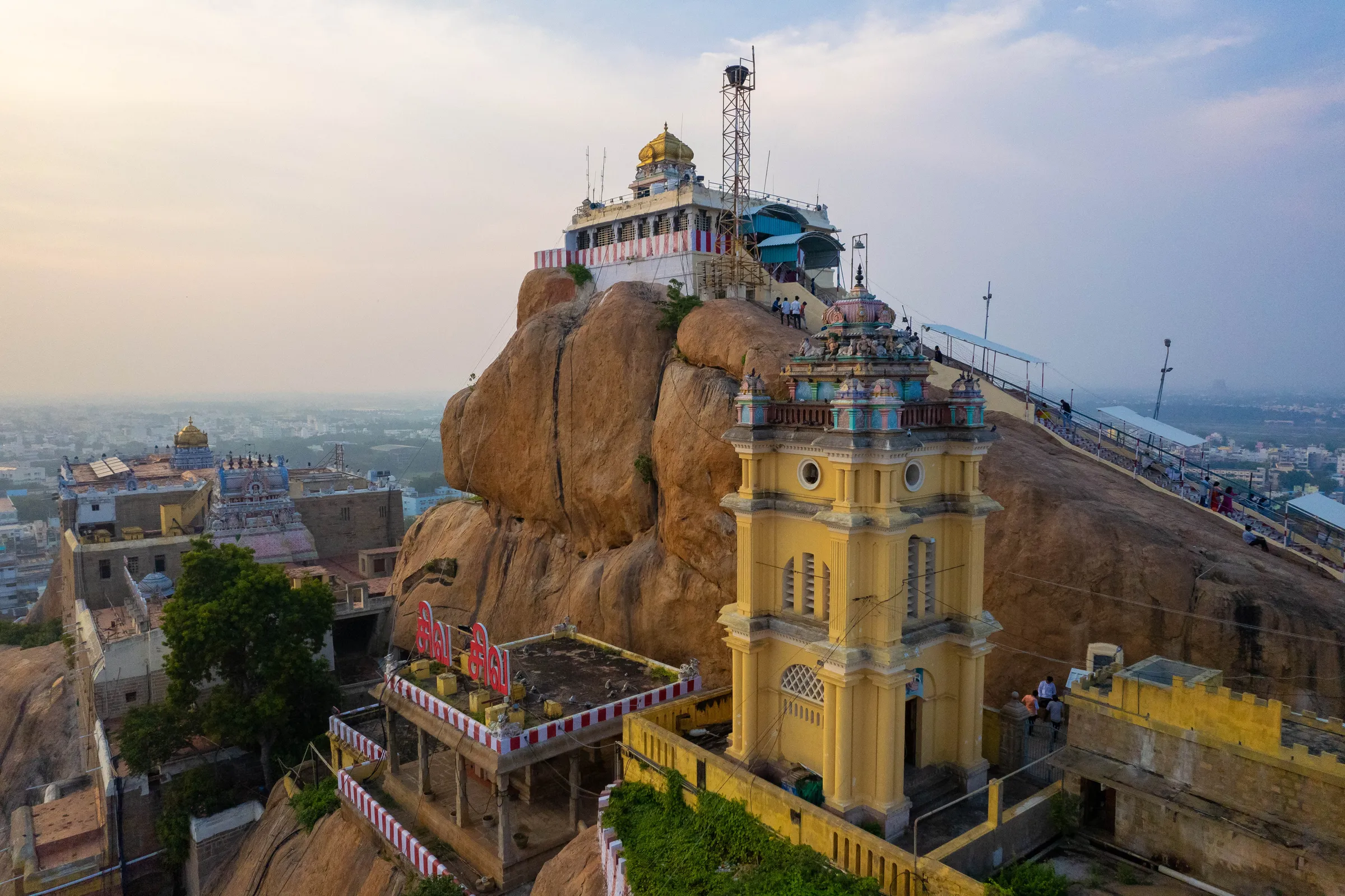
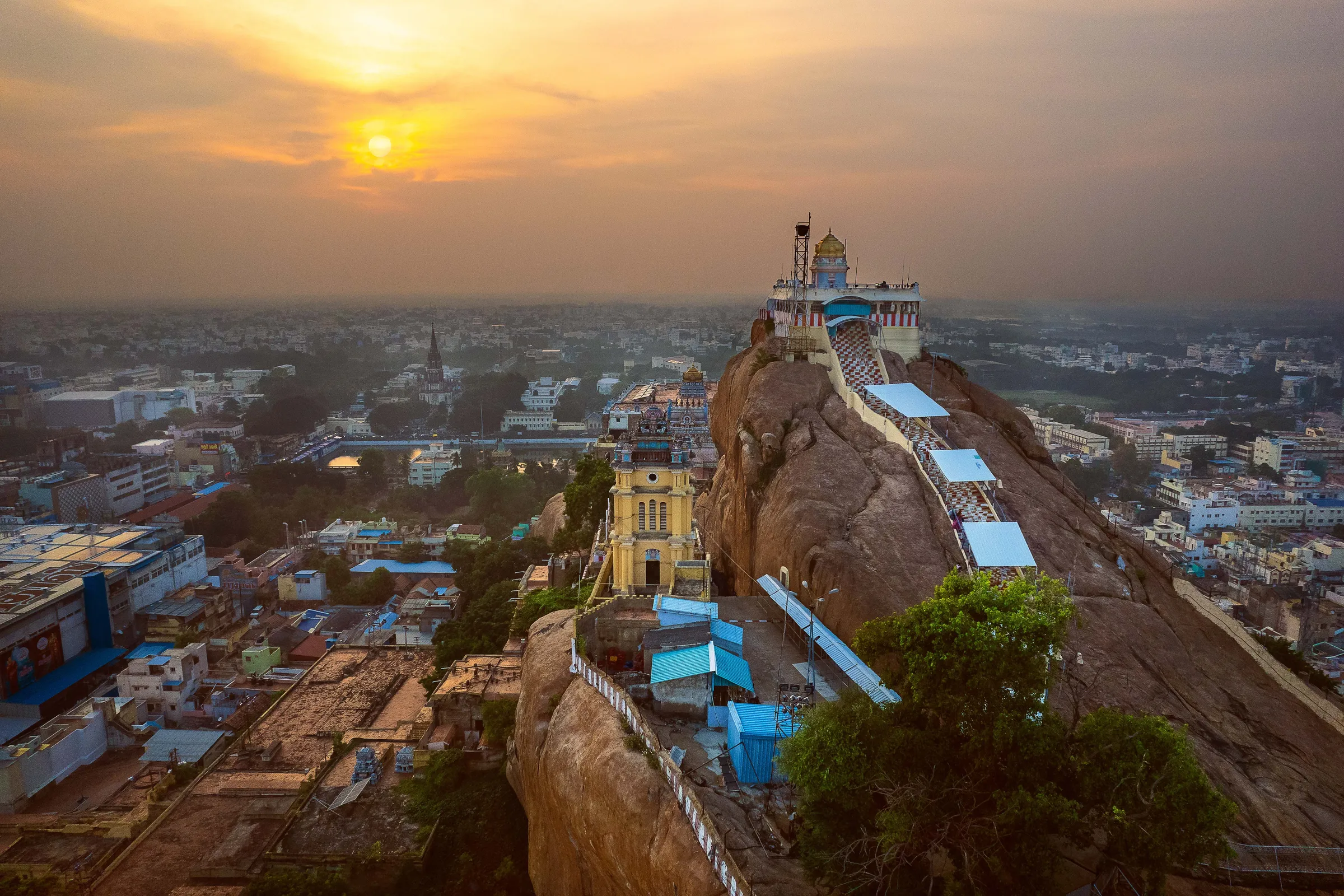
Malaikottai Temple, photograph
← Chola Nadu
Entry 057

Malaikottai Temple

Tiruchirapalli · Pallava (cave temples)

The temple complex of the Trichy Rock Fort, set on rock said to be 3.8 billion years old: the Thāyumānasvāmi temple to Śiva, the Ucchi Piḷḷayar and Manikka Vināyakar temples to Gaṇeśa, and Pallava rock-cut cave temples.

The photographs

Plates · 2

Malaikottai Temple, photograph
© Amar Ramesh and team · All rights reserved
01

Architectural

structure & vocabulary

The Thāyumānavar temple, largest of the three and set halfway up the Rock Fort, is a columned structure dedicated to Śiva as Thāyumānavar, the lord who became the mother, with his consort Pārvatī as Maṭṭuvār Kuḻalammai. The central shrine of Thāyumānasvāmi stands a level above the lower half that holds the consort's shrine, the lower level also holding niches of Vināyaka, Ārumugar, the Navagrahas and Vīrabhadrasvāmi. The walls around the central shrine carry Dakṣiṇāmūrti, Sōmāskanda, Naṭarāja, Sūrya, Brahmā and Durgā. The Ucchi Piḷḷayar temple to Gaṇeśa sits at the top of the hill, reached by steep steps cut in the rock, much smaller, with wide views of Trichy, Srirangam and the Kāveri and its tributary the Kollidam.

The upper cave temple, named the Lalitāṅkura Pallavēśvara Gṛham in its inscriptions, holds opposite its sanctum a celebrated panel of Śiva as Gaṅgādharamūrti, sculpted to overlook the Kāveri, with Sanskrit verses in Pallava Grantham on the pilasters praising it. The lower rock-cut temple of the 7th century shelters life-size sculptures of Gaṇeśa, Kārttikeya, Brahmā, Sūrya and Durgā in its niches, with two sanctums at its ends, one holding a bas-relief of Viṣṇu with two dvārapālas, and a frieze of bhūta gaṇas above the front pillars that includes a notable monkey-faced gaṇa. The Gaṇeśa relief here is important evidence of the Gāṇapatyam cult in the region.

02

Archaeological

dated & cited

The upper cave temple is assigned by its inscriptions, in Pallava Grantham, to the period of Mahēndravarman Pallava (600 to 630 CE), who is said to have tried to build a sanctum for Śiva here. The Gaṅgādhara panel may be read both as Śiva and as Mahēndravarman, who imagined himself as great as Gaṅgādhara holding the Ganges, here his own Pallava kingdom, in his matted hair while overseeing the prosperity of the Kāveri. The lower cave temple shows a man severing his head in offering to Durgā, the Arikaṇḍam done by war heroes for victory. Stone inscriptions and artefacts of the 8th century, and sculptures under the Thāyumānavar Sannidhi, give evidence of Jain monks, making Trichy one of the places with traces of Jainism. The rock itself is said to be one of the oldest formations in the world at 3.8 billion years, bearing quartz and feldspar; the fort played an important part in the Carnatic Wars.

Dating

The upper cave temple is assigned to Mahēndravarman Pallava (600 to 630 CE); the lower rock-cut temple dates to the 7th century.

03

Mythological

as transmitted

By legend the rock at the hilltop is the place where Lord Gaṇeśa ran from King Vibhīṣaṇa after establishing the Raṅganāthasvāmi deity at Srirangam. It is the custom to pay obeisance to Manikka Vināyakar at the foot of the hill before climbing to Ucchi Piḷḷayar at the top.

Register interest in prints Buy the book
Improve this entry

This is an open, reviewed record. If you have spotted an error or have something to add — a correction, a date, a source, a name in another script — propose it. Every change is reviewed before it joins the record.

“Suggest an edit” opens this entry on GitHub and turns your change into a pull request. “Share feedback” opens a short form. Both go through review.